

The short version: reply within 5 minutes and you're roughly 21× more likely to qualify a lead than if you wait 30 minutes. In home services, almost nobody does — because the person who should answer is halfway up a ladder. An AI receptionist closes that gap without you hiring anyone.
The 5-minute rule, refreshed for 2026
The original number comes from the MIT / InsideSales study written up in Harvard Business Review: reply within 5 minutes and you're about 21× more likely to qualify a lead than at 30 minutes. That study has been re-run half a dozen times since — the exact multiplier moves, the shape of the curve doesn't. Every fresh replication says the same thing: the drop-off in the first hour is brutal.
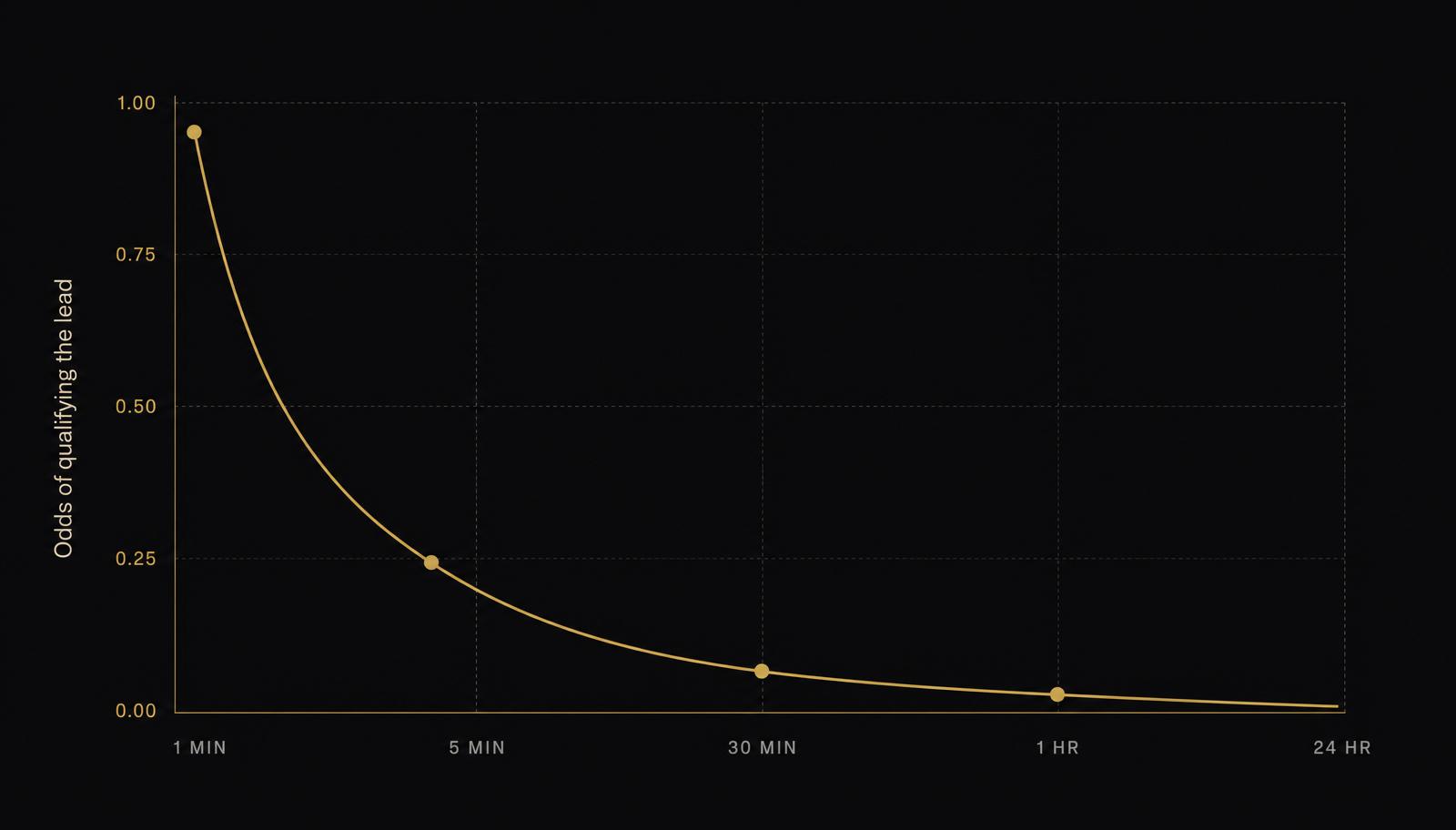
What's changed since the original study is what homeowners expect. In 2026, people book plumbers the way they book Ubers — they submit a form, glance at the phone, and if nothing pings back within a few minutes they submit the next one. You're not competing with the "next-day callback" any more. You're competing with the next tab.
Why home services keep missing it
Hatch's 2024 industry benchmark put it clearly: only ~3% of home service pros reply to a new inbound lead in under a minute, and 88% take longer than 5 minutes. Not because they don't care. Because they're doing the actual work:
- 1. You're on a roof and can't hold a phone.
- 2. You're driving between jobs and won't text back for 2 hours.
- 3. The lead lands during a survey — you see it at 6pm, four hours later.
- 4. The lead lands on a Saturday, when nobody in the office is checking.
- 5. You reply — then the homeowner is now at dinner and doesn't reply back until Monday.
None of that is a discipline problem. It's a structural one. The person best placed to respond is the person least able to answer their phone.
What a slow reply actually costs
Put real numbers on it. A UK trade running a modest £500/month Meta budget might reasonably expect 30–50 leads a month at £10–£15 a lead. If you reply to half of them inside 5 minutes and half of them the next day, the "next-day half" will convert at a fraction of the fast half — usually a third or worse. That's not the lead source under-performing. That's response time silently deleting the return on ad spend.
| Response time | Rough close rate | What it means for 40 leads / £500 spend |
|---|---|---|
| Under 5 min | 20–30% | ~10 booked jobs, £50 cost per booking |
| 30 min – 2 hr | 8–12% | ~4 booked jobs, £125 cost per booking |
| Same day (evening) | 4–7% | ~2 booked jobs, £250 cost per booking |
| Next day | 1–3% | ~1 booked job, £500 cost per booking |
Same ads, same budget, same landing page. The only variable is how quickly somebody replies. That's why speed-to-lead is the single highest-leverage thing most trades can fix in 2026 — cheaper than switching agencies, faster than rebuilding a website, and it compounds every campaign you'll ever run.
Why "I'll ring them tonight" is a losing move
Five years ago, phoning back at 7pm was fine. In 2026 it isn't. The average homeowner submitting a form for a quote fills in 2–4 forms in the same session — one to you, the rest to whoever else appeared in the ad break or the search results. By the time you ring back at 7pm, one of your competitors already answered at 7:03pm the moment they submitted, walked them through the job, and pencilled in a survey for Thursday.
You didn't lose the job on price or on skill. You lost it because someone else answered the door first. That's the real cost of "I'll deal with it tonight" — and it doesn't show up on any report.
What an AI receptionist actually does
An AI receptionist is a small, sharp bit of tech sitting between your lead form (or missed call) and your calendar. The homeowner submits, and within 8 seconds they get a real, conversation-quality reply — over WhatsApp, SMS, or the same channel they used. It asks the questions you'd ask if you weren't up a ladder:
- 1. What's the job? (new roof, blocked drain, bathroom refit — routed to the right pipeline)
- 2. What's the postcode? (so it can filter out anything outside your service area)
- 3. Rough budget or size of the project?
- 4. How urgent — this week, this month, or planning ahead?
- 5. Best time for a 15-minute call or on-site survey — and it books it straight into your calendar.
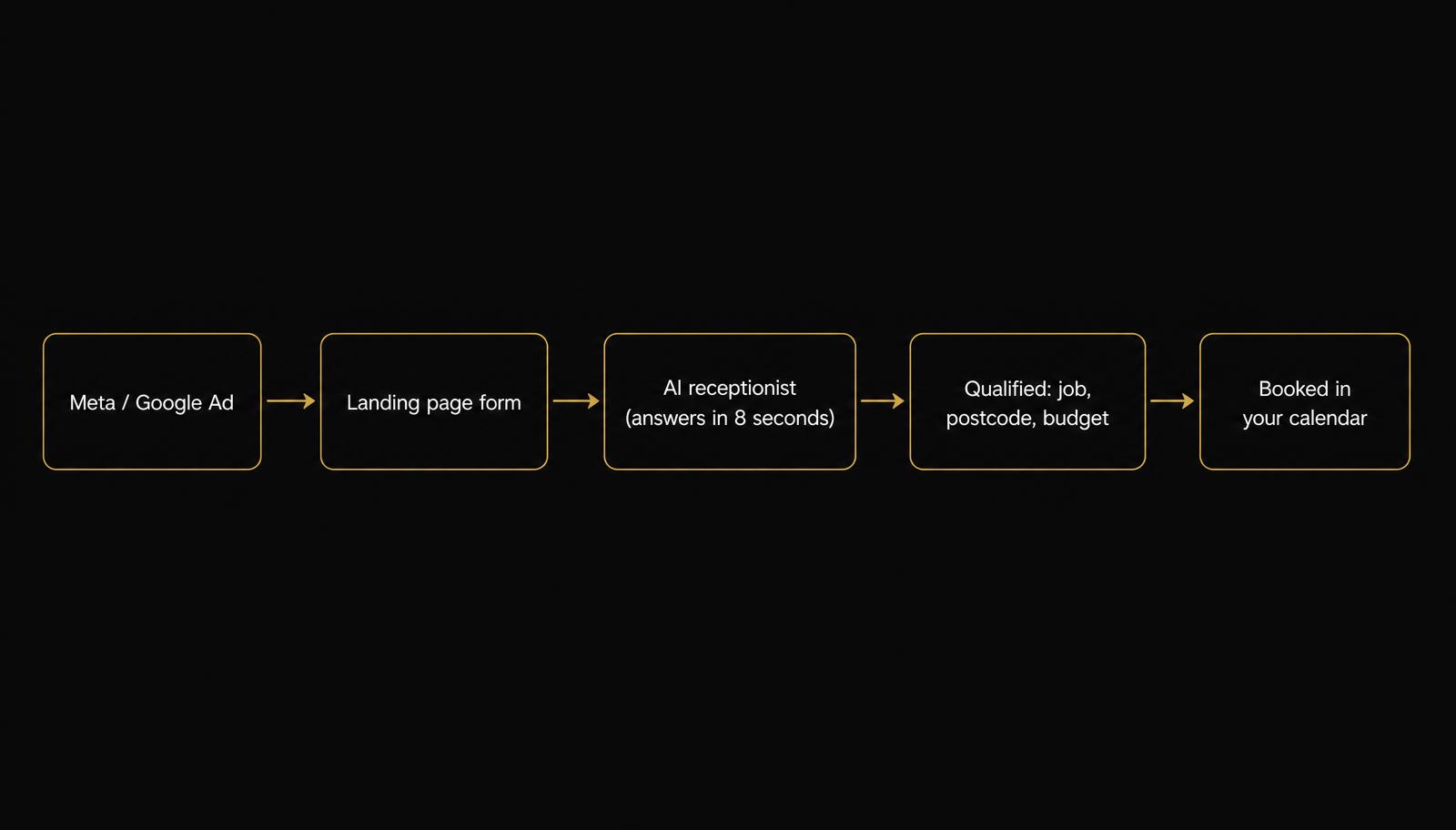
By the time you climb down and check your phone at 5pm, the lead you didn't have time to answer is already qualified, filtered, and booked in for a survey on Thursday afternoon. Same ad spend. More booked jobs. No new hires.
What it doesn't do
- 1. It doesn't pitch or oversell — it qualifies, then hands off to you for the actual quote.
- 2. It doesn't pretend to be human when asked directly. In 2026, homeowners spot that instantly and it kills trust.
- 3. It doesn't replace your judgement — it captures the job so you can price it properly, not commit blindly.
- 4. It doesn't book unqualified rubbish. Wrong postcode, wrong trade, tyre-kicker budget — filtered out before it touches your calendar.
- 5. It doesn't spam. One reply, one follow-up if they go quiet, then it stops.
Realistic numbers on a live setup
For a UK trade already running paid ads with a decent landing page, wiring in an AI receptionist typically shifts the numbers like this in the first 60 days:
| Metric | Before | After |
|---|---|---|
| Average time to first reply | 3–6 hrs | Under 30 sec |
| Leads that get any reply at all | 60–75% | 100% |
| Lead-to-booked-quote rate | 12–18% | 25–35% |
| Weekend leads recovered | Almost none | Nearly all |
| Hours you spend on lead admin | 5–8 / week | Under 1 / week |
None of that requires more ad spend. It's the same top of funnel, plugged into a bottom that doesn't leak. If you're currently spending £500–£2,000/month on Meta or Google, the cost of the AI is usually recovered in the first week — the rest of the month is upside.
How to set it up in a week
- 1. Day 1 — Map the qualifying questions. Write down the 4–5 things you always ask a homeowner before you commit to a survey.
- 2. Day 2 — Connect the lead source. Meta lead form, Google form, website enquiry, missed call — all feed into one inbox.
- 3. Day 3 — Set the calendar rules. Which slots are for surveys, which for quotes, how many per day, and your service-area postcodes.
- 4. Day 4 — Write the tone. Short, plain, no exclamation marks, no emojis, sounds like a receptionist who knows the trade — not a chatbot.
- 5. Day 5 — Test it live with 5 real leads and read every reply. Tune anything that feels off.
- 6. Day 6–7 — Turn it on for real, keep watching the transcripts for a fortnight, then stop worrying about it.
Frequently asked questions
Won't customers hate talking to an AI?
In 2026, no — as long as it doesn't pretend to be human and doesn't waste their time. A fast, useful reply that books a real slot is far better received than a "we'll get back to you within 24 hours" auto-responder. What kills trust is either lying about being human, or replying in a way that clearly hasn't read what they wrote.
What about GDPR?
Standard rules apply — you're the data controller, the AI is a processor. You need a privacy notice on the form, a lawful basis (usually legitimate interest for responding to an enquiry), and the same retention window you'd use for any lead. Nothing exotic.
Does it replace missed-call handling?
Yes. When someone rings and you don't pick up, the AI texts them within seconds with: "Missed your call — [Firstname] on the tools. What's the job and postcode? I'll come back to you today with a slot." That single message recovers a huge chunk of the calls most trades quietly lose to voicemail.
How much does it cost?
For a single trade business, expect somewhere in the region of £150–£400/month depending on volume and whether it handles voice as well as text. On a £500/month ad budget, the extra booked jobs usually cover it several times over.
Does it work with GoHighLevel / Jobber / ServiceM8?
Yes — most modern setups drop straight into GHL, Jobber, ServiceM8, HubSpot, or a plain Google/Outlook calendar. If we build it for you, we plug it into whatever you're already using so nothing on the day-to-day changes.
Can I still take the leads myself when I'm free?
Absolutely. The AI is a safety net, not a gatekeeper. If you jump in first, it steps out of the way. If you don't, it handles it. Best of both.
The takeaway
Speed-to-lead is the least glamorous, highest-return lever you have in 2026. Homeowners book the trade that answers first, and no amount of clever ad copy overcomes a 4-hour gap between form-fill and reply. You can't sit by a phone all day, and you shouldn't have to. An AI receptionist answers in seconds, qualifies properly, books straight into your calendar, and quietly compounds the return on every pound you already spend on ads.
At Onyx we build this end-to-end — the ads, the landing page, and the AI receptionist sitting behind them — because there's no point sending you more leads if the bottom of the funnel leaks. If you want to see what your own setup would look like, we'll map it out for you honestly. No pitch, no pressure.